


In the early 1830s the bottoms along Dunkard Creek were a remarkably different place than they are today. Long fields stretched along the banks, and all land suitable for farming was cleared. Wooded hollows flowed up the steep valleys of the side streams that fed the waters of Dunkard and a few scattered settlements with small cabins and the occasional homestead could be found in some locations.
Such a small settlement existed in western Wayne Township, where the Pennsylvania and West Virginia forks of Dunkard meet. In the 1770s and 1780s several families set up their roots there, mostly folks that had moved west from the Monongahela River, people who originally came from places in eastern Pennsylvania, Maryland, and Virginia. This small settlement for most of its early life never really had a name, though it would eventually be known as Dent and, later, Brave.
The Shanes and the Lantz families were probably the first families to settle nearby, The Cumberledge and Dye families settled around the same time, and in the years that followed, the Cox, Stiles, Wiley, and Anderson families would call this place home as well.
James Dye had built a large mill on the Pennsylvania fork of Dunkard just about a mile above the settlement. He was a well-known justice of the peace who married most of the folks in the area and took care of any minor legal disputes. George Shanes and John Lantz had very large, profitable farms, and a good deal of the people living in the “neighborhood” lived on their land as tenant farmers helping to bring in their crops and manage livestock.

The idea of community in this time wasn’t just a happy ideal, it was a form of survival. Everyone brought something to the table and working together kept things going. In times of trouble a neighbor was always there to help, and when it was time to build a barn or till a field everyone took part. Political affiliation or petty differences didn’t matter. People got along as best they could, that’s the way it must be when agriculture is the primary industry.
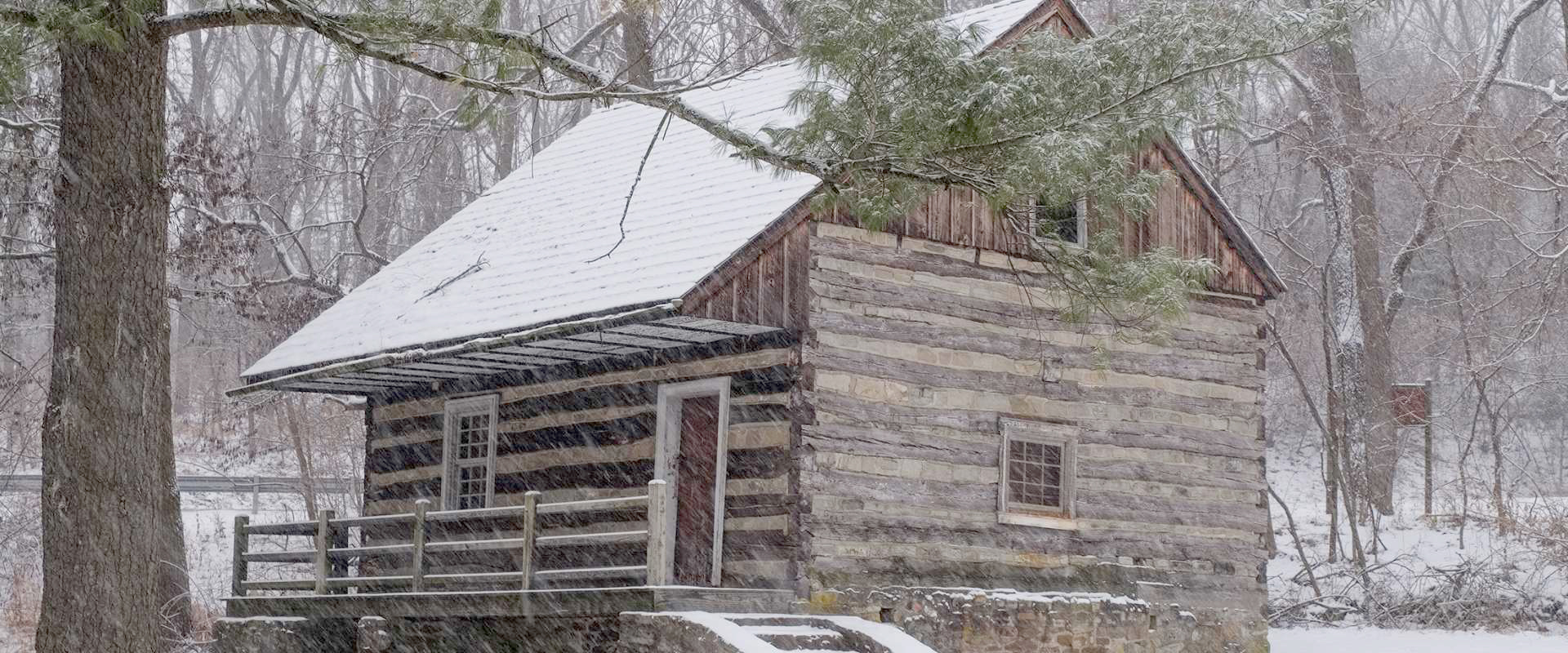
Even as late as the 1830s most everyone was still living in a simple cabin of hand-hewn logs; the bigger brick and frame farmhouses didn’t really start showing up until the 1840s and 50s. A common cabin of the day would have consisted of a structure about 15 by 20 feet, with a door on the front and back, and maybe a window or two. A large fireplace would have dominated one of the end walls with either a small winding stair or a ladder reaching up to a second floor that was typically a few logs high and nestled in under the roof rafters.
Furnishings would have been sparse. The first floor would have held a bed stead, a simple table with a few stools and some shelves fixed into the log walls to hold wood or pottery dishware, or for the well-to-do, maybe a few pewter vessels. Clothing would have hung from pegs on the wall, and children would have slept in the loft upstairs. In the coldest weather, it’s likely the whole family would have slept in the main room nearest the warmth of the fire.
Wealthier families may have had a second cabin that served as a kitchen. Kitchens would often be housed in separate buildings to mitigate damage in the event of a fire. The property may have had a barn or a few other outbuildings. Most fencing used for livestock would have been made of logs stacked in a crisscross pattern, and some were importing multifloral rose to grow around fields to use as a living fence.
In the wintertime, specifically in February and March, it was time to make maple syrup. To make syrup, you collect sap from a maple tree, and the best time being when there are freeze/thaw cycles over the course of a single day. The cycles get the sap moving in the tree and makes it easier to collect. After collecting the sap, you would then reduce it into syrup over a fire.
On March 22, 1834 that’s exactly what the folks of the settlement at the forks of Dunkard were doing, as many would recall years later.
Daniel Cumberledge a young man of 20 had been courting a Miss Sarah Wiley, daughter of John Wiley, the owner of a neighboring farm. They had grown up together and had spent quite a lot of their youth helping with the other young people in the settlement bringing in crops and doing a lot of work on their own farms and for their neighbors.
John Cox, a childhood friend of both Dan and Sarah would reminisce in his later years that it was sometime in March that Daniel and Sarah got married, because everyone in the settlement had been out making maple syrup and stopped for the day to go to James Dye’s place to watch Daniel and Sarah get married. Priscilla Dye, another childhood friend, and daughter of James Dye would have similar memories that she would write down years later. Priscilla was an official witness to the wedding and was the first to give her congratulations to the married couple. After the wedding, everyone, including Daniel and Sarah, would return to their work of making syrup.
 Daniel and Sarah would remain married until Daniel died in 1896, and Sarah would follow him a few years later in 1900, but it was after Daniel died that all these stories and remembrances of their wedding were recorded. Daniel had fought in the Civil War, and after he passed Sarah filed for a widow’s pension, and there was a great deal of firsthand testimony in the pension file that talked about they day they got married. Priscilla Dye, later married to Peter Meighen, gave a very lengthy account, as did John Cox. The terms “settlement” and “neighborhood” were commonly used by many people to describe the area in which they grew up in the testimony in Sarah’s application for a widow’s pension.
Life is so rushed today, and with all our digital devices and constant connectivity, I think we all sometimes yearn for these simpler times. Sure, life involved a lot more hard work back then, but working together like they did in these small farming communities brought everyone together, and community mattered. Thankfully, Greene County today still enjoys some of that old fashioned community spirit, but just think how much better it could be if we would get off our phones and tablets and get out and help our neighbors and become and even stronger community, helping, making a difference, and just getting along as best we can.









Beautiful article Matt ! You changing professions has been a blessing for many people ! I love your work and always look forward to your “posts”!!