


One of the most frequently asked questions I get is: “What Can you tell me about the history of my house?” Unfortunately, this often requires a lot of in-depth research, and sometimes there simply isn’t much to be learned. It can even be very difficult figuring out exactly what year a house was built.
There are, however, some places you can begin your journey. Your first stop should be the courthouse, to look at the deed history of your property. It is rare, but occasionally, there may be specific mentions of the house or descriptions of it that may help you in your quest for information. Tax records, held in the County Office Building, may also be of assistance. Most tax records will indicate what year the house was built; however, such a date should always be taken with a grain of salt as often it is merely an estimate. I have seen dates of construction that were obviously inaccurate. However, Deed and Tax information can give you an idea of the people who may have been living in your house at various points in time.
Most people who are looking for information like this are asking about an older house, generally built before 1900. If you live in Waynesburg, or a couple of the other larger towns in the county, Sanborn Fire Insurance Maps can give you some help. For example, if your house shows up in an 1891 Sanborn Map, you know it was built before 1891. Sanborn Maps can be very easily found online, through the “Resources” page of greeneconnections.com.
For Waynesburg itself, the 1901 Book “Waynesburg Prosperous and Beautiful” might also contain some useful information.

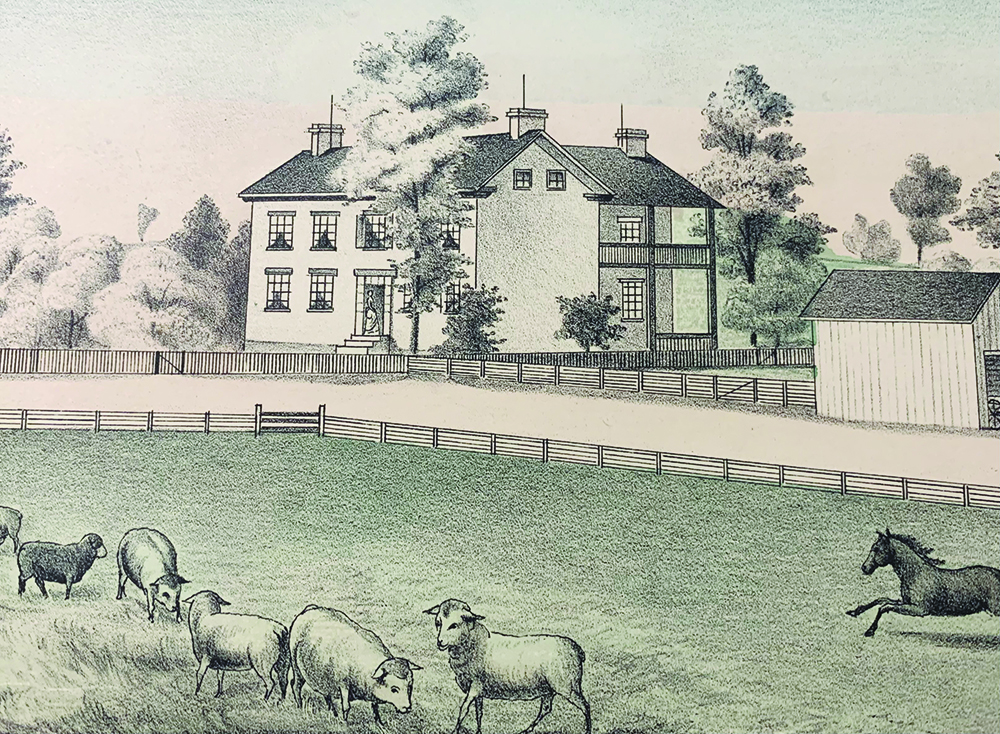
If you live in the more rural parts of the county however, learning about the history of your house can be much more difficult. It may be impossible to figure out exactly when it was built. In this instance, it is always worth checking Caldwell’s 1876 Atlas of Greene County (This can also be found on the resources page of the Greene Connections Website.) Many farms were illustrated in the Atlas, and you may be lucky enough to find an early image of your home.
Perhaps where Caldwell’s Atlas can be most useful is comparing your home to others illustrated in it. The architectural features of a house are often the best, and sometimes only, way to figure out the age of a house. A general rule of thumb is, if the woodwork inside and outside of your home is extremely fancy, with many designs and eccentricities it most likely dates to the Victorian Period, approximately 1870-1900 or a little later. If it is more plain with a lot of straight lines, it most likely dates to an earlier period, perhaps as early as the 1830s.
Unfortunately, this is a difficult area of research, but these few tips can give you a place to start. You can always email the Greene County Historical Society at gchs1925@gmail.com, and we can provide a few more tips for places to research. In addition, it is always worthwhile to search the Greene Connections archives. You never know just what you might come up with.