


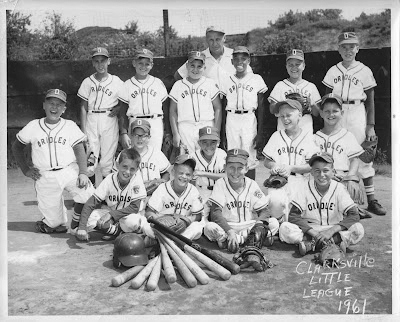
In 1960, there were six separate Little League baseball organizations in Greene County. Waynesburg, West Greene, Clarksville, Greensboro, King Koal, and Greene Valley all had their own leagues and sent their champions to a year-end tournament at Mon View Park in Greensboro. The 1961 championship was claimed by the Rotary team from King Koal, who were led by battery mates Tom and Jerry McCombs. They defeated the Clarksville Braves, Waynesburg Legion, the Greensboro Sox, and Dry Tavern Reds on their way to the crown.
That year, the sport was so popular that Waynesburg added a Senior Little League and a Minor League. That would have been almost 50 teams providing recreation for boys. Each team created friendships and memories that would last a lifetime for those young men.
All that was necessary was a glove and transportation to practices and games. Decent gloves were $7.00-12.00 at Murphy’s or Western Auto. The recently introduced Wilson A2000 was an exorbitant $20. If you were still playing in high school, you might have gotten one under the Christmas tree. The transportation was usually handled by a carpool of moms with half the team piled into a station wagon.
I’m not naïve enough to think these Sandlot/Field of Dreams recollections have any chance to survive in today’s culture of technophiles, corporate greed, and delusional helicopter parents.
However, is it too much to ask that we let kids be kids and explore other sports and activities before we have them dedicate their lives to an almost certain quixotic pursuit of “big time” athletic success. Perhaps we could hold off on that level of commitment at least until the kid is certain it wasn’t Santa Claus that put the A2000 under the tree.
I understand there are myriad reasons why youth sports participation is down; however, one factor is easily identifiable. In recent decades, youth sports have increasingly shifted toward a model dominated by travel teams—selective, competitive groups that prioritize skill development, frequent competitions, and exposure over community-based participation.
Today, sporting goods manufacturers charge parents a couple hundred bucks for that A2000 and two and a half times that for a personal bat. Add to that spikes, batting gloves, and a personal batting helmet and equipment bag for a $1,000 barrier to entry for most kids.

That’s before a single day of work is missed for a tournament five hours away…. which also requires a hefty sum for hotel rooms.
While travel teams offer benefits for highly talented athletes, they also impose significant harm on traditional youth sports leagues that were once the backbone of community engagement, physical activity, and character building for children of all abilities.
Those leagues historically offered inclusive environments where children of varying skill levels could learn and enjoy sports. With the growing allure of travel teams, many of the most skilled players and committed coaches leave rec leagues behind. This talent drain weakens the competitive quality and leadership structure of community leagues, making them less attractive to participants and parents, creating a feedback loop of declining interest and participation.
In addition, the emphasis on competition and early specialization within travel teams can also lead to burnout and injury. Young athletes are encouraged—or even pressured—to commit to one sport year-round, reducing their opportunity to explore different activities. Moreover, multiple studies have shown that early specialization can increase the risk of overuse injuries and diminish long-term athletic development.
Socially, travel teams can foster exclusivity and undue pressure. This can alienate children who are less competitive or late bloomers, which leads to deceased participation. In contrast, rec leagues promote teamwork, friendships, and community identity—offering benefits that extend far beyond the playing field.
By centralizing elite development and sidelining broad participation, travel teams ultimately narrow the pool of future athletes, coaches, and fans, weakening the foundation of sports culture in general.
Unfortunately, the root of this misguided movement lies in the unrealistic dreams of proud parents. Statistical analysis is not the strong point of a father who has convinced himself he could have made the majors if his high school coach would have allowed him to switch positions.
The last kid from Greene County to play in a major league game was Dick Gray of Jefferson………in 1959. Furthermore, I don’t have to take off my shoes to count the number of kids from Greene County who got some Division I scholarship money for baseball (let alone a full ride).
If a parent’s plan to pay for college is rooted in Junior’s ability to hit a curve ball or register 95 on the radar gun, I would suggest a more grounded fiscal approach.
Community leagues offer far more than a playing opportunity—they provide a space for learning, belonging, and community cohesion. Ensuring their survival and growth is not just a matter of preserving tradition but of promoting health and enjoyment for all young athletes. For the sake of long-term development, youth sports must find a better balance between elite competition and community engagement.