

October is by far my favorite month, and I know many people feel the same way. The weather, the foliage, and football are at their apex in my opinion.
Many of the festivals and traditions associated with the season balance cozy reflection and lively celebration. This is especially true of the tradition of “homecomings.”
Today, almost all of us have the same collective memories of football games, pep rallies, bonfires, and dances. However, these traditions, like others, evolved slowly over the years.
While the core elements of homecoming have remained consistent, modern celebrations often include additional activities. However, the primary focus to unite the community remains the same. The name perfectly captures the essence of the event: the act of returning home to where friendships were made, and where a sense of belonging was first forged.
Collegiate Origins
Multiple colleges claim to be the progenitor of the homecoming tradition.
Of course, Harvard and Yale claim their traditional rivalry games dating back to the 1870s were the original homecomings. However, most historians give one of three other Mid-western schools credit.
In 1909, Baylor University held a large alumni gathering during a football game. The following year, the University of Illinois staged a big alumni weekend tied to multiple athletic events.
However, the University of Missouri (1911) is widely credited with hosting the first official Homecoming. The story goes that Missouri’s athletic director, invited alumni to “come home” for the annual football game against their big rival Kansas. To encourage attendance, the school planned parades, rallies, and events around the game.
The gathering was an immediate success, sparking similar events at other colleges across the country. Schools quickly recognized that homecoming was more than just an opportunity to boost school spirit. It was a way to strengthen the connection between alumni and their alma mater….. and get money from them.
Why Football?
Originally, many alumni weekends were scheduled around commencement. However, attendance was usually sparse and drew mostly local graduates.
Savvy, administrators understood the need for a more enjoyable inducement to bring people back to campus. Football was central to early Homecomings because it was by far the biggest spectator sport on campus at the time. These games drew townspeople and alumni in addition to current students. The big rivalry game gave schools a natural anchor for a gathering.
Eventually, colleges realized they needed to schedule “cupcakes” for easy victories to keep the morale high on campus for the after-game festivities.
The games created an excuse for alumni to travel back, see old classmates, and show pride in their alma mater… and donate money. By the 1920s, the tradition had spread across the Midwest where college football was booming.
These early Homecomings typically featured a parade with floats by student groups, pep rallies and bonfires, and a dance or banquet for alumni. The tradition of crowning a Homecoming Queen did not become part of the celebration until mid-century.
Waynesburg College/University Homecomings
Like many colleges, Waynesburg’s Homecoming began as an opportunity to draw alumni back to campus to watch a football game and reconnect with friends and faculty.
Though precise dates of the earliest Waynesburg homecomings are hard to pin down, the first mention of a “homecoming football game” on the schedule came in 1938. The Jackets tied St. Vincent 0-0 in that November 13th game to share the Class B Title with the Bearcats. (Their only losses that year were to WVU, Duquesne, and Fordham). However, the yearbook did not mention any activities surrounding the game.
The first mention of a Homecoming Court and festivities did not occur until the post-war period. The earliest photographic evidence of such a celebration was 1947 when Prexie Stewart crowned a queen at halftime.
By the 1950s and 1960s, Homecoming at Waynesburg had expanded into a full weekend.
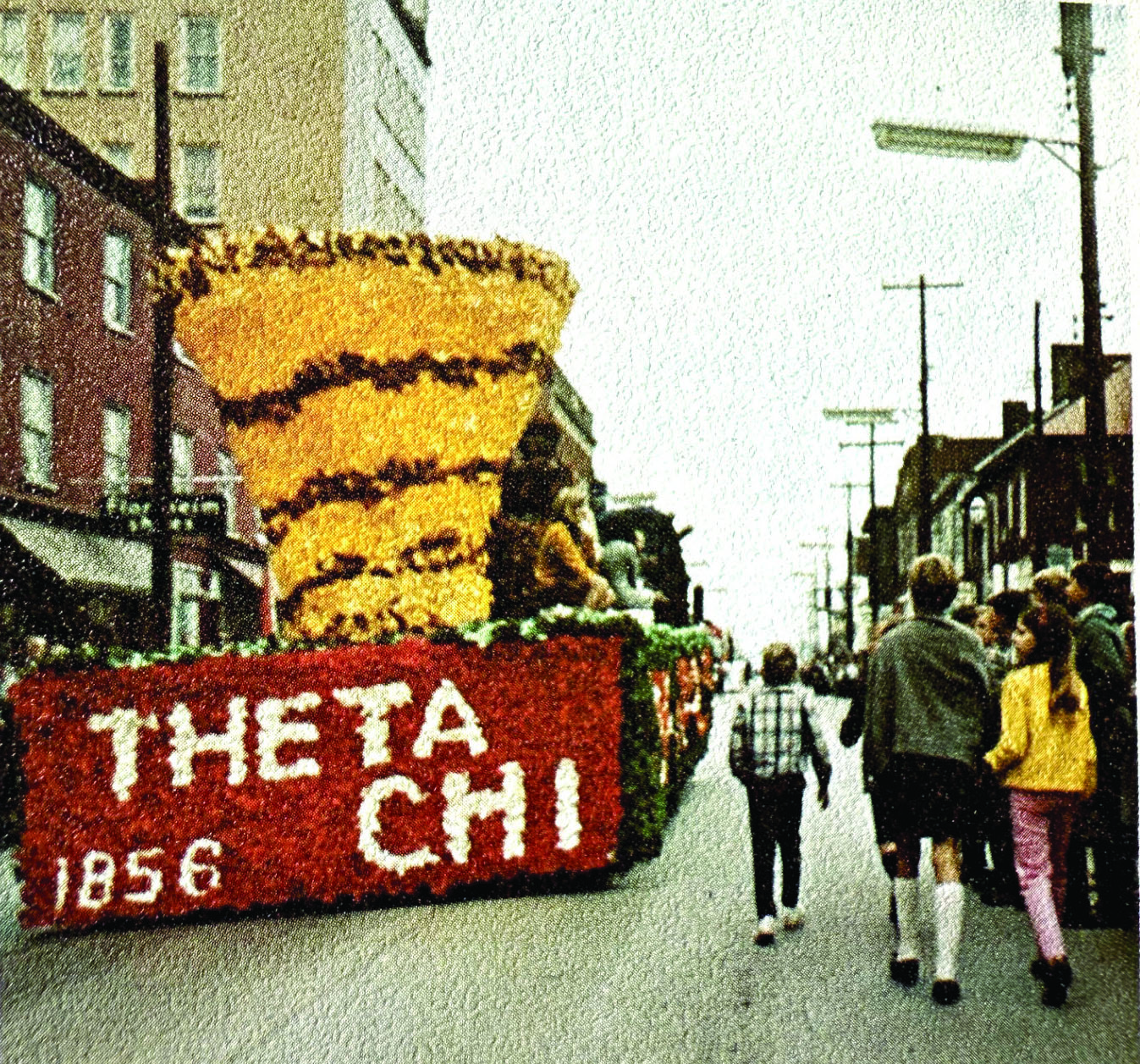
There were parades through the borough, featuring floats created by student and Greek organizations and even community groups. The Queen Coronations at halftime became a beloved custom. Alumni Luncheons and Banquets brought generations together during the day. More importantly, depending on your age, Alberts, Rohanna’s, the VFW, the Elks, the Jury Box, and the Waynesburg Hotel brought alumni together after the game.
It was during these years that Homecoming solidified as a highlight of the college calendar, a mixture of school spirit and community festival.
Local High School Homecomings
By the 1930s, high schools (especially in the Midwest and South) began to adopt the tradition to build spirit, honor alumni, and showcase school pride. The idea was to invite graduates “home” for the big game, just like universities did.
The earliest high school homecomings included events like the colleges’ celebrations. There were parades, pep rallies, bonfires, and a dance, which was often the biggest social event of the school year.
Unlike colleges, where alumni were the primary focus, high school homecomings quickly became more about students—with alumni welcome but less central.
By the 1940s and 1950s, most high schools had added the Homecoming Queen and King tradition. This became one of the most recognizable parts of the ritual, symbolizing school spirit and student popularity. Crowning the queen at halftime of the football game became standard practice nationwide.
I always assumed the tradition would have been around in Greene County high schools for years. It turns out that my parents who graduated in the 1950s would have never experienced a “homecoming queen.”
After researching the yearbooks of the five county schools, I was surprised to find that we were relatively late to the party. In the 1950s, there were many queens in those pages: Coal Queen, May Queen, Prom Queen, Cinderella, and Miss Merrie Christmas…. but no Homecoming Queen.
Finally, in 1957 Mapletown listed a homecoming queen among the others honored in the yearbook. Carol Stoneking was crowned at the final game of the year on the first Friday in November. Alumni who graduated in years ending in four and nine were also honored at the game. A dance was sponsored the following night by the junior class.
In 1956, Waynesburg High School chose a “Football Queen” at their last game. That tradition would last five years before they finally selected Brenda Meek Baker as their first “official homecoming queen” in 1962.
A year later, West Greene’s yearbook featured a spread entitled “First Homecoming a Success”
The accompanying copy predicted the event “will become a tradition.” After the parade, the Pioneers defeated Clay Battelle in the game and crowned Queen Ada Lou Andrews at halftime. The next night the Journalism Club sponsored the Homecoming Dance.
Carmichaels and Jefferson didn’t crown queens until 1965 (Janice Lindstrom) and 1966 (Melvina Collage) respectively.

By the 1970s and 80s, high school homecomings expanded even further. While football remained central, high schools added new twists such as Spirit Week, hallway decorating contests, and powderpuff football games.
Ultimately, homecomings endure because they serve multiple purposes.
They are a celebration of shared history, memories, and pride. They serve as a way to build school spirit, create traditions, and bring together past and present members of the community. For many students, the sense of belonging fostered during homecoming events stays with them long after they graduate.