

Greene County is no stranger to rural beauty and the charming lifestyles the countryside can offer. That charm would not be complete without its plentiful farms, featuring dozens of animals to point out on Sunday drives. These animals are fun to admire but also serve their purposes beyond entertainment. No one can attest better to this than those who tend to these animal farms, whether for commercial reasons or as a hobby.
“I grew up in a neighborhood where there wasn’t a lot of space for farm animals,” said Jessica Bland, a UR nurse at UPMC who has been living in Waynesburg for over 15 years with her husband, Adam, and their three children. “I knew as a kid I loved being around animals and learning about them, but I did not intend to become a hobby farmer and knew very little about farming prior to starting out.”
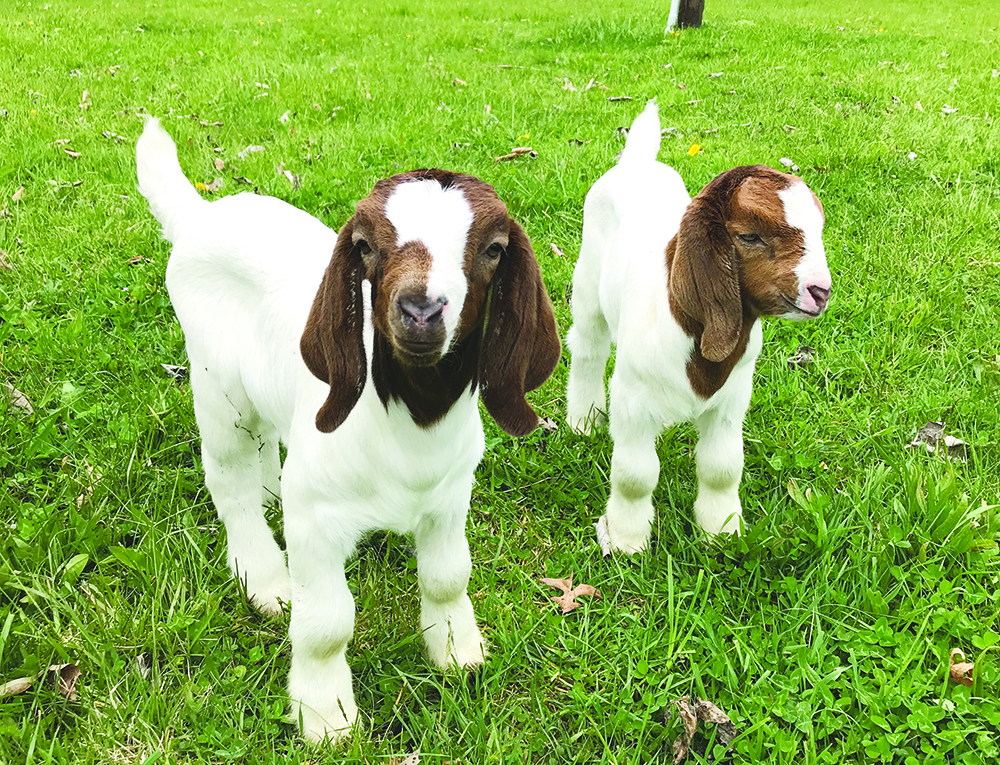
Despite never intending to start the hobby, Bland and her husband decided to buy three goats around 2015, which gradually turned into adopting additional goats into the herd every six months or so. After three years, they tried their hand at breeding and were successful in adding kids to the farm family.
“For our ten-year anniversary, I hinted to Adam about wanting miniature donkeys,” added Bland. “I told him we really needed them to protect my goats from coyotes. Of course, he surprised me with two jennies. First thing we learned is don’t mix donkeys and goats.”
With the new faces came new fences and more opportunities to grow. About a year into donkey farming, they bought some jacks from a friend and began breeding mini donkeys. They sold the foals even though they got quite attached to them in the six months the babies had to spend with their mom after birth.
The Blands are not the only Greene County residents who have learned the ups-and-downs of raising goats and other farm animals. Mike and Lisa Belding both discovered their passion for farming and agriculture at a young age. Mike grew up on a small sheep farm and participated in 4-H programs and the Future Farmers of America in high school before obtaining a degree in Agriculture Science from Penn State University. Lisa was raised in a small farming community in eastern North Carolina, working in tobacco fields before heading off to North Carolina State University to study education.
“While preparing for retirement from the Marine Corps, (we) sought to move back to Southwest Pennsylvania and give (our) children an opportunity to raise farm animals and live in a rural community,” said Mike Belding. He was commissioned as a Second Lieutenant in the US Marine Corps in North Carolina, where he met Lisa. “Throughout the years of moving around in the military, there was always a desire to get back to the farming environment.”
Although it took nearly thirty years, Mike and Lisa finally settled in Greene County in 2012 when they found and purchased a small farm for sale close to where Mike was raised. They were accompanied by their son, W.D., and their daughter, Jessie, who were in ninth and tenth grade at the time. Although they had visited Greene County over the years, the big move was quite a change from their experience of moving every three years on military orders. Anticipating this significant lifestyle transformation, they called their property “Leap of Faith Farm”.
Given the topography of the land, Mike’s earlier farming experiences, and the relatively small property, the family decided to first focus on raising goats. They started by dividing their property into several pastures with fencing and water, then built an additional barn and a chicken coop. Over the years, they have raised rabbits, chickens for eggs, steers, and barn cats along with maintaining a few large vegetable gardens. Still, their most numerous livestock, like the Blands, are goats.
“It is both rewarding and challenging to raise goats,” said Belding. “They do make good pets if someone would like just a couple goats, but I would say in large numbers, there are three things to consider when preparing to raise goats – protection, shelter, and health programs.”
Both couples emphasized the importance of protecting their goats from threats such as coyotes and roaming dogs. Secure fencing is also essential as goats can quickly become little escape artists if it’s not done properly. Goats also require warm shelter as they are not big fans of cold, wet environments. Additionally, herd health depends on a strict regimen of nutrition, parasite prevention programs and hoof trimming.

“The reality is farming is a lot of trial and error. You learn by doing,” said Bland. “If you are considering starting a farm, just make sure you have the time and resources to do so. The animals depend on you for all their needs.”
Raising cute animals can be worthwhile, but there are challenges to getting started. Extensive research is necessary to know what to expect and how to best prepare to bring your first animals home. Belding recommended approaching a new farm like any other enterprise. One should develop a traditional business plan with a business description, intended products, market analysis, operational details, financial projections, and organizational and management details.
Although both families are currently down-sizing their farms due to their children leaving the nest, they still enjoy the few animals they decided to keep. For Jessica and Adam, this includes their goat herd, dogs, a cat, a horse, and a mini donkey with special needs named Twitch. Leap of Faith Farm, on the other hand, has several honey bee hives, a couple feeder steers, a handful of barn cats, and a spoiled potbelly pig named Lemon.
Goats can be a great introductory livestock to kick off a farming experience. Farming can be especially rewarding for children as they learn a great deal from the time and effort required to care for animals. For those curious about starting their own farm, there are organizations and individuals that are happy to share their experiences and guidance for new farmers such as the County Extension Offices, Farm Bureau members, 4-H and FFA programs.