


With the dogdays upon us, I thought it would be interesting to take a look at the most blistering summers of our past. Greene County is blessed with a relatively moderate climate compared to the rest of the world and nation. Our average July high temperature is a nice (for some people) 84 degrees. However, in the past we have endured some brutally hot days.
The hottest month on record in Greene County occurred in July 1901. That month, the county experienced an average temperature of 77°F, with daily highs around 90.
The last two weeks of that July were devastating for the entire East Coast. Conservative estimates placed the death toll from the heat wave at 9,500 in the cities alone. Undoubtably, this was a gross underestimate because many immigrants and rural residents were not included in the count.
Rail lines warped, disrupting travel. What few electrical grids there were at the time failed. Horses died from heat exhaustion in the streets creating dangerous sanitation conditions.
This was a year before Willis Carrier even invented the prototype of the air conditioner and two decades before the first refrigeration units. It would be years before these items were common in most homes.
I went to the Cornerstone Genealogy Library, and their helpful staff allowed me to search the Waynesburg Republican of the time period to see how the heat affected Greene County.

The Waynesburg Chamber of Commerce was first organized during that year. I can imagine the merchants trying to convince the townsfolk to buy some heavy Edwardian clothing to add to their suffering.
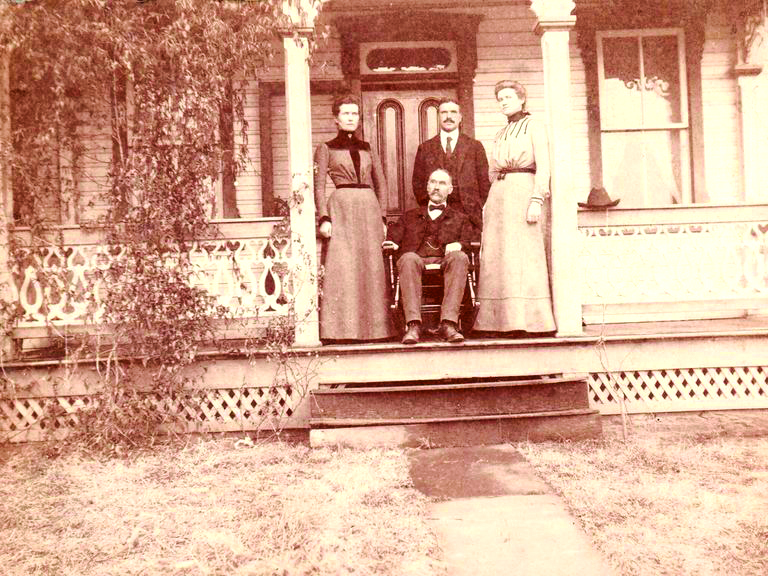
In 1901, women’s fashion was characterized by a continuation of the late Victorian silhouette, featuring long, flowing skirts. Day dresses often had high necklines and were adorned with various trimmings. Men’s fashion included three-piece suits, high-collared shirts, and neckties. Working men wore canvas, duck cloth, or corduroy (often with protective aprons)
One can only imagine the uncomfortable nightmare these garments would bring to the average person in the street. Waynesburg Business College, which was on High Street, canceled classes on several days. Most church services were being held under tents.
The plight of the blue-collar workers during these times would seem unfathomable. However, in these conditions even they were granted a reprieve. Most of the sheet and hoop workers in our factory were idled because of the dangerous conditions.
One of the many intense evening thunderstorms caused by the heat took the life of a 35-year-old Whitley Township man. He was standing in the middle of his downstairs bedroom, and a bolt of lightning traveled down the chimney and struck him. Another lightning strike hit a Carnegie Company gas well derrick near Waynesburg, and it burned for several days.
A large ad in the Republican counseled people to drink Hire’s Root Beer to beat the heat. It was advertised as “The Nation’s Temperance Beverage” with “Pop-Fizz, Foam, and Sparkle!”
Meanwhile, according to another article, breweries in Pittsburg (no “h” at that time) and Wheeling were working overtime to make enough beer to quench men’s thirsts.
One venerable institution found a way to beat the heat. An “Ice Cream Social” was hosted by the Christian Church at the Jacktown Fair. “Three well conducted young ladies were stationed around each table to take and fill orders of cream and lemonade.” Apparently, it was “quite an attraction to the many young men present to partake in the delicious refreshments.”
The fair crowd was larger than expected, but the “officer of the peace” was not required to control the crowd because they were “well entertained by the music of Mr. and Mrs. James Carter”
A cheeky, popular columnist for the Pittsburg Post, who went by the moniker of The Green Goods Man, ran a humorous column listing the telegrams he received from his “country friends.”
Some of the “telegrams” were as follows: In Claysville, potatoes baked in the ground and chickens hatched prematurely (one half at a time) due to the heat. In West Alexander, farmer Butabaga had his thermometer upside down and lost an ear to frostbite. The village of Good Intent, which consisted of three sycamore trees and a duck pond disappeared because of the heat, and all the village’s mail should be sent to the Burnsville Post Office. Finally, in Waynesburg the fish boiled in the stream and were fully cooked. He also noted the oil drillers around here liked the heat because it saved them the trouble of lighting the fires under their boilers.
As one does when looking at old newspapers, I went down a rabbit hole of exploration of the crazy things going on at the time. First, I found it interesting that a man named Alex Ashbrook shot a crane in West Waynesburg that measured 6’6” from tip to tip. Of course, such news could be found in the Waynesburg Republican and Pittsburg Daily Gazette of the time. The two papers were running a subscription special where you could receive both for the low rate of $3.00 a year.
However, the most amazing thing I saw was the Pittsburgh Pirates were in first place in the eight team National League standings. They finished the year seven games ahead of the Philadelphia Phillies. Interestingly, that was the first season for the American League. The inaugural World Series was two years away, and the Yankees were seven years from even existing.
1934
July of 1934 was the second hottest month on record here. The average temperature was 76.5°, highs again near 90° every day.
By this time, some public spaces in cities had large window air conditioners. However, the units were $7,000 to $14,000, the equivalent of $100,000 to $200,000 in today’s money.
That whole summer the entire country baked. In fact, most of the 1930s saw severe droughts and poor soil conservation, leading to dust storms and crop failures. Bare, dry soil and lack of vegetation amplified heat through radiative heating and dust storms.
However, 1934 -1936 were particularly bad. Temperatures in the Plains often reached 110 to 121 degrees. New York City recorded multiple days of 106. Many of those highs still stand as records today. Forty-five of the 48 states recorded temperatures over 100 in 1934.
The death toll that summer was also listed as approximately 9,500. In addition, there were massive crop failures, especially corn and wheat. Livestock perished from heat and lack of water, creating food shortages on top of the depression’s economic impacts.
1955
In more recent local history, July 1955 stands out as the third hottest month in Greene County, with an average temperature of 75.9°F and daily highs also peaking at 89°F.
Air conditioning was still rare at that time around here, available only in select public buildings (like movie theaters). Most homes relied on fans and shaded porches. The broader national disaster accelerated interest in modern cooling systems and public health planning.
Recent Years
Five summers ago (the summer of Covid) was not far behind on the list. The average July temperature of 75.8° was no doubt uncomfortable; however, the effects were not nearly as devastating given the ubiquity of home and commercial air conditioning.
The summer of 2024 was the hottest on record globally, surpassing previous milestones set in 2023.