


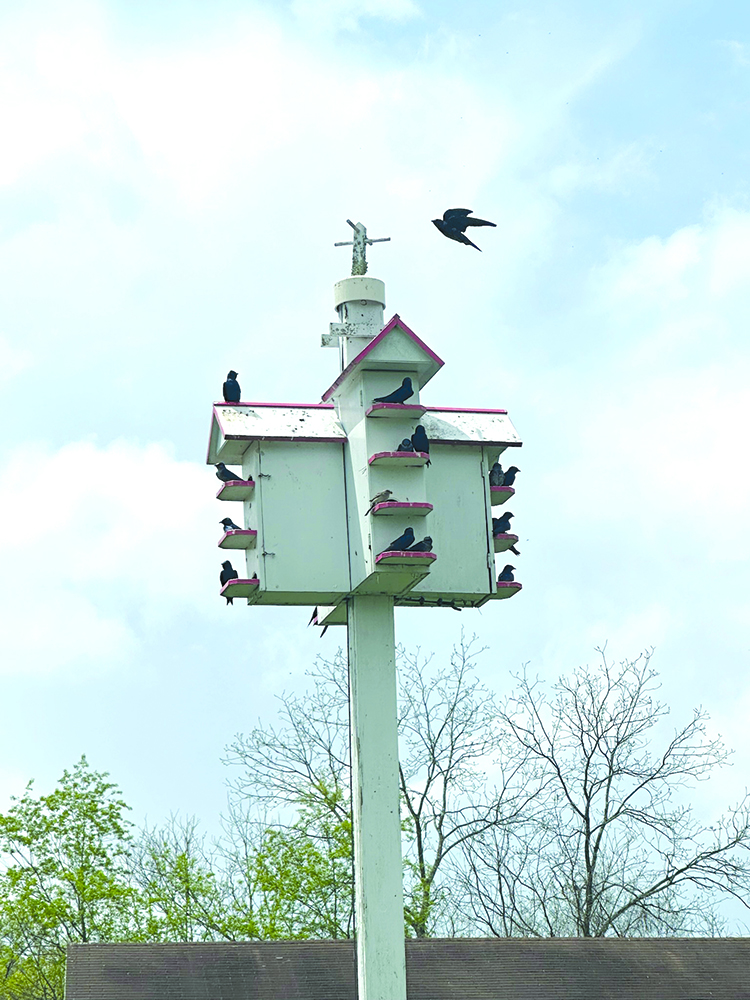
Now that spring is in full force, Greene County residents might notice a few feathered guests soaring across the sky. With their striking raven and plum-tinted plumage, purple martins have now settled into the greater region to nest, breed, and raise their young. This unique, omnivorous species of migratory birds travels across the Americas, settling mostly in Brazil during the fall and winter and heading into North America for the spring and summer.
However, the most unique feature about these birds is they live in what is called a colony, comprised of dozens of individuals that nest in close proximity to each other. These colonies are often in compartmentalized human-made structures that are specifically designed for them (usually made from wood or hollowed and dried gourds).
One of the most prominent local places to see these beautiful birds is at the Mason-Dixon Historical Park, located on the border of Greene County and Core, WV. Established in 1994, the park’s purple martin colony is maintained by park employees and members of the Dunkard Creek Watershed Association.
Every April, approximately 30-40 purple martins return to the park to lay their eggs in the safety of the sanctuary and raise their young. The sanctuary box has 14 individual nesting boxes that must be monitored by humans to ensure the survival of the chicks. Martin fledglings are susceptible to fleas, blowflies, and predatory birds (like sparrows and starlings). Humans must clean out their boxes and provide them with fresh nesting materials to help the baby birds thrive and carry on the species’ survival.

“Come check them out for yourself and set up around their nesting area,” said Angela Hinerman, Superintendent for Mason Dixon Historical Park. “They tend to stay within eyesight of the colony, and you can watch them perform aerial tricks for hours, catching bugs out of the air.”
Hinerman urges community members to help in the park’s conservation efforts of these unique avian friends by refraining from the use of any pesticides/rodenticides/insecticides and spreading the message about their need for human intervention and help. She also suggests establishing and monitoring your own colony if you live in an area where the birds can thrive.
“Purple martins like to nest in wide, open spaces where water is nearby to stay near their greatest food source, flying insects,” says Scott Cavallaro, owner of Wild Birds Unlimited Morgantown. “If you have that close to your house, you have a chance of successfully establishing a colony of your own and becoming a purple martin landlord.”
And while these birds are eye-catching and entertaining, having purple martins in your community can actually serve a practical purpose, benefiting farmers and gardeners in reducing the invasive insect population.
“They act similar to bats, swooping and grabbing any small flying bugs they can catch, like mosquitoes and fruit flies,” Cavallaro added. “They’re a great form of natural pest control.”