

Men’s fast pitch softball became a very popular sport in the US during the 1930s and 1940s. Local leagues sprang up all over the country. Pitchers that could hurl the ball over 85 mph at a batter 46 feet away could strike out 15 to 20 batters a game. To make things even more difficult, the underhand delivery meant the ball could rise and drop with incredible motion.
The Amateur Softball Association was formed in 1934. Soon there were state and regional tournaments all over the country selecting teams to vie for the coveted National Championship. Competition was fierce among teams to recruit the best pitcher around. It was not unusual for a talented pitcher to be recruited by the winning team after his team was eliminated from a tournament. Often, these “amateurs” were making a fair living playing softball.
In the early 60s, Brave was dominant in the area in men’s fast pitch. Their pitcher Bob Burgman was nationally known and often pitched for “big time” teams. He commanded local mounds from 1950-91. In 1961, he pitched for Philadelphia at the Softball World Series. In 1961, Huck Tennent pitched the Brave team to the West Virginia State Finals.
In the early 60s, there was also an adult church fastpitch league in the county. The teams included: Ruff Creek, Fairall, Spraggs, Morrisville, First Christian, Washington Street Methodist and First Baptist. In 1960, the Baptists and star pitcher Pete Walker went 24-2 in the regular season. Walker had a 12-1 pitching record, a .603 batting average, 16 homeruns and 16 doubles. He was one of the area’s premier players for the two decades of fast pitch softball’s popularity. By 1961, there was an Independent League. Waynesburg’s Wonder Bar defeated Mather three games to two in the championship series. The series featured Wonder Bar’s Walker against Mather’s Muscles McNeely.
There was also a Big 4 League that included: Rich’s Mobile Homes, GI Town (Clarksville), Gigi’s Shoemakers (Carmichaels), and the Dilliner Miners. Rich’s won the 1962 title with a 45-5 overall record after going undefeated in the league regular season. They competed within the league as well as against independent teams such as Brave.
Many of us are old enough to remember when local tournaments were huge events around the county. The annual tournaments drew large crowds to watch teams from around the region. The Brave tournament was the oldest (started 1949) and largest in the area until the Waynesburg Lions Club tournament (started 1964) surpassed it in size and reputation by the late 60s. Burgman was the pitcher for the winning squad the first three years of the Lions tournament. He accomplished the feat for three different teams – Brave, Curry’s of McKeesport, and Zane’s Bar.
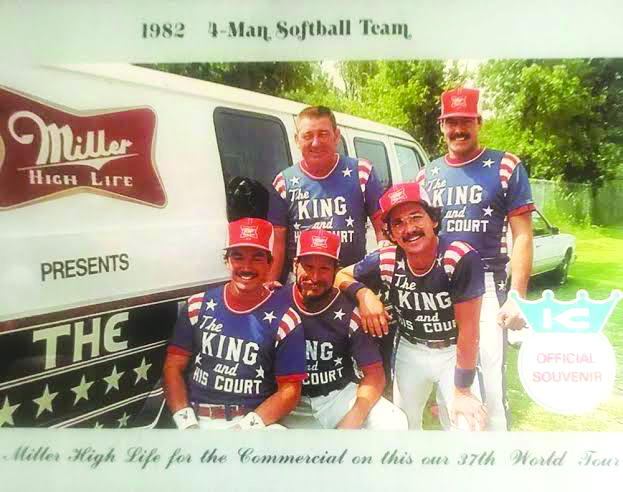
At the 1965 Waynesburg Lions Club Tournament, Brave tied the King and his Court 2-2 in an exhibition game. The famous four-man touring team was led by the legendary pitcher Eddie “The King” Feigner. In his career, the King threw 930 no-hitters and 238 perfect games. (Another team of County All-Stars lost 1-0 to the King in 1983. The game was played on the Waynesburg High School football field in front of packed stands, and Pete Walker pitched for the locals.)
In 1969, Waynesburg’s Guthrie Truckers defeated Burgman and Zane’s Bar in the finals of the Lion’s Club tournament. As a result, they earned another birth to the KASA state tournament. That tournament was held in Waynesburg at three local fields. College Field, Emerald Field, and Meadowlark Park all hosted games. The tournament was won again by Sal’s Lunch, who then went on to win the national title.
In 1970, the Truckers did what no area team had done. They won the State Championship and went on to the World Tournament in California. Before the team could attend the World Tournament, funds needed to be raised. Local businesses stepped up and sponsored each player and manager. The business would get a big write-up in the Democrat- Messenger with the player’s picture for its sponsorship. The trip cost $273 ($219 for the flight and $54 for the motel room). The Truckers lost a close 2-1 contest to eventual champion Houston, Texas. This would mark the high point for men’s fast pitch in the area.

The following year, they became the Triangle Truckers. They once again qualified for the State Tournament; however, they finished second after falling to Nazareth 2-1 in the finals. Walker had pitched a perfect game in the semi-finals and was named the tournament MVP. Members of the team during their runs included: Dave Cosgray, Marty Doney, Gary “Shade” Cole, Dave Sowden, Jeff Criss, John Summersgill, Gary Vukmanic, Bob Watts, Myron McMinn, Larry Wilson, Dana Filer, Bob Iams, Paul Ankney, John Edgar, Ernie Chadderton, Keith Haney, Dave Pritchard and Bob Iams. Jim Moore and Bob Rohanna both served as managers during various years. Rohanna was also an occasional pitcher for the squad.
From 1964 to 1979, the Waynesburg Lion’s Club Tournament drew huge crowds to College Field and later the Fairgrounds. The evening would begin with a slo-pitch contest and be followed by two fast pitch games under the lights. The fast-pitch division was a highly competitive affair that saw the area’s best athletes compete for the title. Burns’ Esso, Red Star and Jefferson Hotel were other highly competitive local teams. In 1974, the tournament format changed to include a women’s slo-pitch division. Fewer fast pitch teams and the rebirth of women’s athletics in the decade led to the change.
By the middle of the next decade, the fast-pitch game had all but disappeared from the area.